Tuesday, May 19, 2015

Payson Temple Open House


Today was our lucky day.  Our day had come to attend the Payson Temple open house and we arrived to sunshine and no rain.  Beautiful clouds but no rain.


We have watched the construction of this temple for years as we drove by monthly on the I15.  Little by little it progressed and soon it glowed at night as workers continued to work.


It truly is beautiful and glorious.  My nephew, Matthew, went with us.  We talked about the three temples we had toured during the last 14 months including the Gilbert Temple, the Phoenix Temple, and now the Payson Temple.


Each temple has been beautiful in its own way.  Each contained decorative symbolism inside and out appropriate to their location.  This temple uses the apple blossom in honor of the acres of fruit trees, particularly apples, planted in this southern part of Utah County.


This temple seems as if it were sculpted from a giant block of solid stone,  Just look at the detail at the corner of this building.


Mathew at one of the main entrances.


The attention to detail is really amazing.


A perfect day for photo taking.  Blue skies, dark clouds, and sunshine.


From the inside, these windows glowed in the sunlight.


The sun shines behind the Angel Moroni, so happy to be seen again.


That star like motif is found throughout the inside of the temple as well as out.


So lovely!


I loved that the flag was flying.


Blue skies contrasted with very dark rain clouds.


We wandered around a bit just south of Payson and showed Matthew Glen's favorite fishing pond in Spring Lake.  It is the one where every grand child catches a fish.  I made him pull over so that I could take a picture of this view of the temple.

Great Granny Squared UFO


Yes, I did manage to finish my UFO for April as part of the All People Quilt UFO (Unfinished Objects) challenge by the end of April.  The binding happened while traveling, but it happened.  I quilted this top on my sewing machine and it took some time.  I love its crinkle look after washing and drying it.


It will be a great pop of color in the smaller quest room with all of its browns.


This room gets used more in the summer when the grand kids come for visits.


This pattern comes from Lori Holt's book "Great Granny Squared" and she included directions for a label for the back, so I did it all.  I made this quilt from 2 layer cakes of Lori's Vintage Modern line as well as two yards of her "fat quarter" fabric which has four different fat quarter like prints per yard.  See more here.

I was going to use Kona White for the backing as I had for the front.  But when Lori's Flower Patch fabric line came out, I just had to use the pink background fabric for the backing instead.


The mini has been on the wall for awhile.


I made it from the left over fabric from my Great Granny project.  The pattern can be found in "101 Fabulous Small Quilts" compiled by The Patchwork Place.  I enlarged the applique piece to 125% and used all pinwheel blocks for the surrounding border.

I am now working on the #12 from the list for May.  It is a Christmas quilt.

Sunday, May 17, 2015

Manasseh Fitzgerald and Melissa Ann Smith


Early photo of Melissa Ann Smith

Manasseh Fitzgerald and Melissa Ann Smith family portrait


Older pictures of the Fitzgerald children and a composite photo of their parents


Manasseh Fitzgerald, son of Perry Fitzgerald and Mary Ann Casot, was born 11 February 1849 at Mill Creek in what would become Salt Lake County, Utah. His father moved to Draper, then called Willow Creek, taking their sons John and Manassah after his wife, Mary Ann, died . When Manasseh was 8 years old he was baptized a member of the Church of Jesus Christ of Latter-Day Saints. In time he was ordained to the Aaronic Priesthood and was interested in the calling of the same. He went to Laramie, Wyoming when there was a call made for emigrants. He was called to Arizona and responded to the call, on account of conditions arising in the country returned with others who came back. He was married to Melissa Ann Smith in the Endowment House, 2 March 1874 by Daniel H. Wells. He was a Ward Teacher for many years. He was a farmer raising sugar cane, grain and fruit. He was a faithful, industrious and honest man. He was fond of telling stories which interested his listeners. He was ordained a Seventy in the Melchizedek Priesthood. Later he was ordained a High Priest which office he held until the time of his death.  He died 2 December 1928 in Draper, Utah.


Melissa Ann Smith, daughter of Absalom Wamsley Smith and Amy Emily Downs, was born 7 October 1853 in Draper, Salt Lake County, Utah.  Children born to Manasseh and Melissa Fitzgerald are: Ellamore born 30 November 1874; Mary Amy born 1 April 1877; Margret Edith born 12 June 1879;  Manassah Orson born 8 December 1881, died 5 February 1907; Annie Ruth born, 4 September 1883;  Melissa Ann born 30 October 1885; Matilda Jane born 15 May 1888;  Heber Alvah born 10 November 1890; and Verna Olive born 15 August 1893.

The family of Manasseh and Melissa Fitzgerald lived on a farm one and a half miles from Draper near the foot of the beautiful Wasatch Mountains. They had nine children. Their daughter, Verna writes: "Along with some riding, there was a lot of walking in deep snow in the winter. Our parents had a light wagon and later a buggy for our transportation. On the Sabbath Day, quilts were put in the light wagon and the whole family went to Sunday School and two o'clock sacrament meeting. Our parents always went with us. There was plenty of work on the farm as there were lots of fruit trees. Being near the mountains, there were snakes. Father never did kill one. He would carry them and they won't bite.  I can never remember one of us being bitten with one." Later the Fitzgeralds sold the farm to the boys and moved into Draper in the second home north of the Draper Bank and just south of the then Utah Poultry.

During the fall of 1919, after graduation from Jordan High School, Verna went to Alton, Kane County, to teach school. There she met Otho Roundy and they were married in the Salt Lake Temple. In Alton there were not many opportunities for schooling and the family decided to move. Manasseh Fitzgerald had passed away and Melissa was living alone in the home. The family offered to sell the home to the Roundys and in August 1829, they settled in Draper.  At this time there were three children; Golda, Kilmer, and Elmo. A third son, Verl, was born later.

Melissa Fitzgerald lived with the Roundys until her death on 30 Oct 1932.
 
The following is a transcript of Fitzgerald family stories told by daughter, Melissa Ann Fitzgerald Smith:

"A long time ago my father used to take his cows away up to the mountains to herd. And he would drive them up there and then he'd herd them all day long. So one day he was up there and as he went to start down home he saw something crawling along behind in the bushes and it was something brown. And he thought it was a bear. And my father had a flipper that he used to flip rocks with and he could just hit anything with this flipper. With a rock.  So he picked up some rocks before he started up with the cows and so he had them in his pocket.  So he took them out of his pocket and he put them in his flipper and he flipped right at that pers... at that bear in the grass and away he went with the cows down home just as hard as they could run. And he got down there and the milk bucket was hanging on the fence and the hired man wasn't anywhere around to help milk. So he took the bucket and started to milk the cows. And he got them nearly all milked before the boy...the hired man come.  And the hired man come and he said, "Say, it was me that hit you with that flipper... or he says it was me you hit with that flipper," and he said "and you knocked me right out and I fell down on the ground for a while after you hit me" and he says "I was just trying to scare you." but he says "Don't you tell your father that it was me that hit you" and he says "I got a dollar here.  I'll give you this dollar if you won't tell your father that it was me that hit you, because if you tell him he'll fire me he won't let me work for him anymore. And so he didn't tell anybody about that dollar he had and he just thought that that dollar was nearly a hundred dollars cause a dollar was pretty scarce in those days. And he kept it hid all the time so in about a year by the time that hired man left them and stopped working there and then he told his father. He went and got his dollar and showed it to his father and told his father about that man hitting him with that there and then he had the dollar to spend.

And he said that it,  and he said in those days why they went bare feet all the time and they run up in the mountains and around bare feeted and why he says his feet got so tough that he could just step on a prickly pear,  and it wouldn't hurt him at all because his feet got so tough and they were just as tough as leather. But that they had to go barefeet so they could keep their shoes for school.

And one day there was a fire started way up in the eastern part of town. Just above our place up there. We lived up close to the mountain. And there was a fire started there. Somebody started a fire. And the wind was blowing so hard and the fire was coming right by our house. And there was only mother and Jane that was home. Father wasn't home. There that fire where some men went up there to try and put it out but the wind was blowing so hard that they just couldn't do anything with it. It was just a going so fast right down to our place and there we have a haystack there and we had a barn there and had two horses in the barn and a pigpen with some pigs in them and there that fire was coming right down to the place and mother and Jane went outside and jane says what do we do we gotta go turn the horses out of the barn they'll get burned up if we don't. And mother stood there for a little bit and she says "oh lets pray" she said "lets pray," and so we stood there and prayed that that fire wouldn't come down on there, burn their place and that wind changed right around and went back the other way. And the men came and put the fire out. That wind just changed and that is a true story. That happened to my mother.

 And another time my father, we lived clear up in the eastern part along about two miles from anybody, we lived up there. And my father was there alone one night and my mother went down to mutual with my sister and they walked downtown two miles to go mutual. And while they were gone my father was sitting there in the house and while was sitting there he heard a voice saying "get up and lock the door and put some papers up to your window." They had little windows about like this... that you could put a newspaper up just for blinds. We didn't have blinds back then we just had newspaper. And so my father looked around to see who was talking to him. He couldn't see anybody. And he sit there for a minute and he heard the voice again. "Get up and lock your door and put some paper up to your window." And father got up and he put the papers up to the window and locked the door. And he just got the door locked and he heard a man come around the house. He heard him walking around the house. And he come around and he banged on the door. He hit on the door and he said "Let me in there!" "And my father said, "I won't let you in and if you don't go away I'll use my shotgun at you." And just then we had a great big black dog that was down by the barn and he come runnin' up the house just a barking. And that man when he heard that dog coming and barking he started to run around the house and away he went. And my Father heard him go clear around the house, just a running from that dog. And the next day why we heard that there was a prisoner escaped out of the prison and that he was seen in the eastern part of Draper. And so it was that man who was up there. I don't know what he'd of done if he had gone in. He might have thought that Pa... my Father had a lot of money but he didn't have any money to give him. Father didn't have ... we didn't have very much money. But anyway he went. And Father done as that voice told him. He put the things up to the window and that.

And one time I had a girlfriend that came to see me and that used to live close to my place. Her mother and my mother used to go to Primary together. And so, one day they went to Primary together and on the way down my mother says I've only got fifty cents to my name in my purse and I owe it for tithing. And I haven't a spoonful of sugar in the house and she said and I don't know what to do. So when they got down to the Primary there was a place where you could go in and pay your tithing. So mother went in and paid that fifty cents for tithing and then went on to Primary. And after Primary they went around by Rideout Store and just as they got in front of Rideout Store my mother opened her purse again and there was another fifty cents in her purse. And she took that fifty cents and went into the store and bought some fifty cents worth of sugar."

Melissa Ann Smith Fitzgerald is the only woman on the front row.

Manasseh Fitzgerald and Melissa Ann Smith in 1928

 
Grave marker in the Draper City Cemetery

Sunday, April 26, 2015

Tulip Festival at Thanksgiving Point


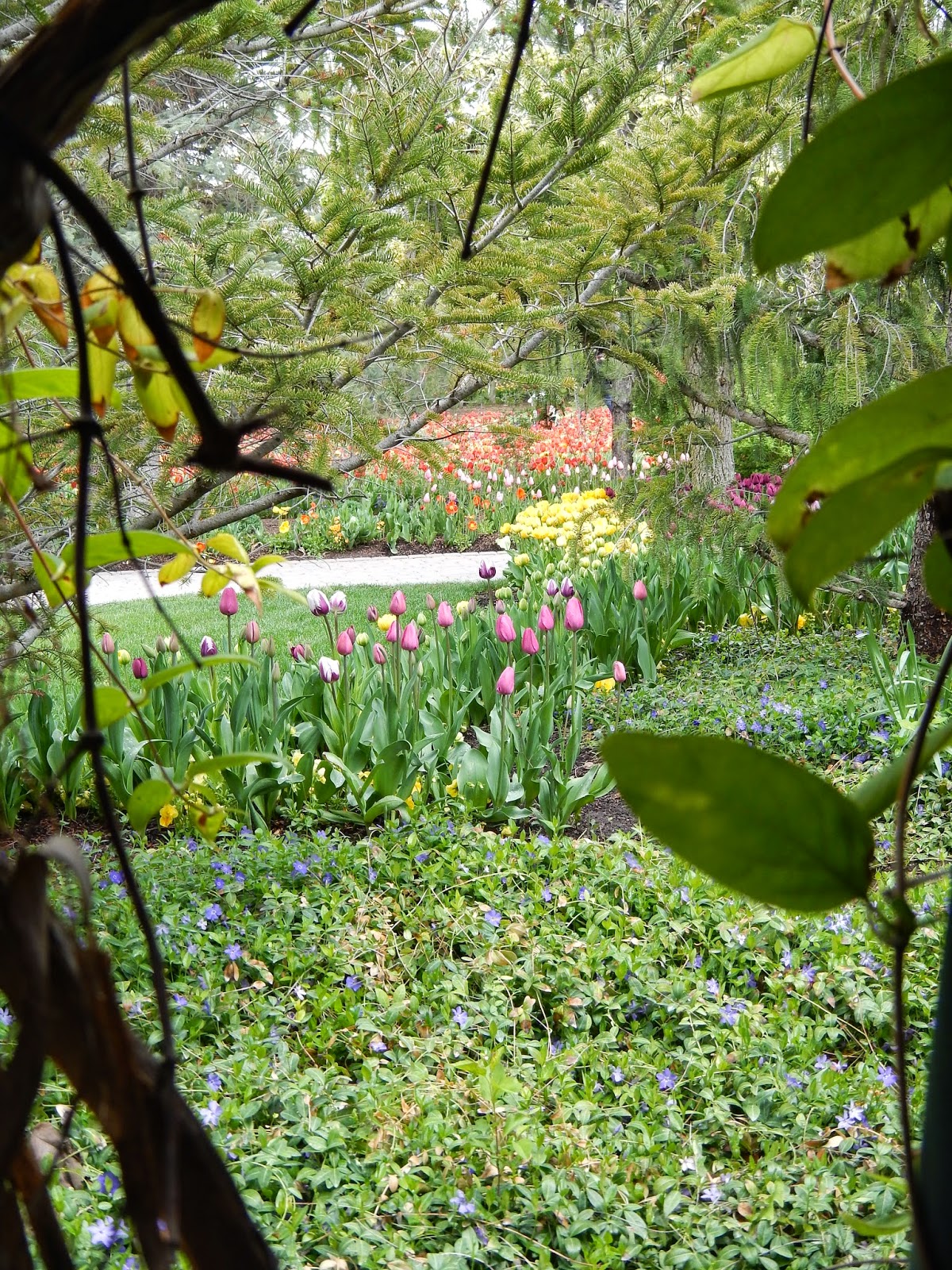
My husband and I celebrated our 40th wedding anniversary on Saturday at the Thanksgiving Point Gardens.  It was Tulip Festival time and it was lovely.  It was a cloudy and sometimes blustery day but the garden was full of color.  Enjoy!


Yes, that is the new NSA buildings (bunkers) overlooking this beautiful garden.  I suppose the trees will grow taller.  We enjoyed lunch at the Trellis Garden Cafe after our stroll through the garden.  It was a wonderful outing.

Sunday, April 19, 2015

Perry Fitzgerald and Mary Ann Cozat (Chasot)


A BIOGRAPHY OF PERRY FITZGERALD

Perry Fitzgerald, son of John Fitzgerald and Leah Phillips (both of whom died in Ohio in 1839), was born December 22, 1815, at Redstone, Fayette Co., Pennsylvania, and was of Scotch-Irish decent. His opportunities for obtaining a scholastic education were very limited but the home training which his parents set before him was the most enabling nature, and they had a marked effect upon his whole life. He was impressed with being completely honest, moral, truthful, and showed proper consideration for his associates, particularly for the aged and unfortunate. He came to Utah in Brigham Young's first company and later made his home in Draper. At the time Draper was called South Willow Creek because the creek flowed from Big and Little Willow Canyon that meandered southwestward through a jungle of willows and trees and along the south boundary of what is now the Draper Park. 

When Perry was a boy there was a strong lure for the western frontier of the growing United States, so when he was about 20 years old he moved to the state of Illinois to a little place now know as Vermillion, where he met and married Mary Ann Cozat. She was born in Mercer, Kentucky on 30 September 1821.  They had 5 boys.  John born 25 March 1840, Daniel born 10 February 1843, Alvah born 28 May 1845 all in Vermillion, Illinois and Manasseh born 11 February 1849 and Perry Jr. born 22 January 1851 both in Millcreek, Utah. 

In 1842, they became members of the Church of Jesus Christ of Latter-Day Saints and moved to Nauvoo, Illinois where the church had established its headquarters after being driven out of Missouri. They settled on 160 acres of land and shared with the saints in their persecutions and cruelties which were heaped upon them. After the assassination of Joseph Smith and his brother, Hyrum, they were driven from Nauvoo with the rest of the saints. They spent the following winter on the banks of the Missouri River at Winter Quarters where the saints were temporarily located. They left most of their valuable possessions behind including Perry's corn cribs full of corn. 

While in Winter Quarters, Perry was chosen by Brigham Young as one of 143 explorers and pathfinders. He was in the first company to journey westward in search of a new home for the homeless and exiled people of which John S. Higby was Captain. Perry was responsible for 2 wagons in the train, his was the second wagon. Perry knew of the hardships ahead, and because Ann was not very strong he left her and his son John with the main body of the church to follow later. The other two boys died of Cholera in Vermillion during a Cholera epidemic; John having survived the disease at that time. John was but 6 years old but he was a big help to his mother and they managed until they could also come West. 

The details of the long hazardous journey to Utah is a matter of history.  Perry arrived in the Salt Lake Valley 24 July 1847, with Brigham Young, and assisted in raising the first flag on Ensign Peak. After one month, President Brigham Young, with a number of other pioneers, including Perry Fitzgerald, started on the return trip back across the plains to Winter Quarters for their families. Brigham selected Perry as his escort. While traveling eastward with light traveling equipment, they met and passed many companies of saints who were on their way to the Salt Lake Valley. In Brigham's company were a few of the Mormon Battalion members who had been honorably discharged in California and were on their way back to rejoin their wives and children. They arrived there and left the next spring for the second time to journey back across the plains. Some of the companies they met when on the way to Winter Quarters were Daniel Spencer, Captain Sessions, Apostle Parley P. Pratt, Apostle John Taylor and Jediah M. Grant.

Having successfully helped guide the first party to the site of the new settlement, Perry headed back east to meet his wife, Mary Ann, who was already traveling across the plains from Winter Quarters with another party, the George B. Wallace party.  The group included Mary Ann, her son John, 7 years of age at the time, her Sister-in-Law Lurena F. Nebeker, Lurena's husband, John Nebeker, and their children. They were among the earliest of pioneer settlers to travel the historic Mormon Trail. 

When they again reached the valley, Perry resided in Salt Lake with his family and assisted in building the fort which is now known as Pioneer Park. It was designed to protect the settlers from Indian trouble of which there were indications. In 1849 he took his family and moved to Millcreek, just a little south and east of Salt Lake and helped build a fort there. During the short time they lived there, two more sons were born; Manessah and Perry Jr.   Perry's beloved Ann passed away at age 30 leaving behind her husband and children, John now l0, Manesseh age 2, and 6 week old Perry Jr. who later died at age 13. Elizabeth Shipley took the boys to care for them at her home in Draper.  After considering the excellent range conditions in Draper (Willow Creek), Perry decided to move there and did that same year and built a small three room house of logs on a high stone foundation on the bank of the main creek. The logs were hauled from the canyon east of Draper. He built it on the north bank of the creek and secured squatters rights to his farm which took in the area between what is now 12400 South to about 13100 South.

Soon he met and married Ann Wilson who bore him two daughters, Mary Ann on 16 September 1852 and Alfreda Ann on 1 October 1855. Water was scarce in Draper and the settlers were afraid there would not be enough water to divide with Perry, but somehow they managed. In order to conserve the water they would go in wagons to the mouth of the canyon where the stream was larger to do washing and water the horses. When the water left the canyon it seemed to soak in the ground, and by the time it reached the homes there was a very small stream. Because of the gravely and sandy nature of the creek bed and the melting snow that decreased in the summer months, they drove their cattle, sheep, and horses to the canyon to water. 

Shortly after Perry married Ann Wilson, he took another wife, Agnes Roylance Wadsworth, 16, who bore him 13 children, seven sons and six daughters. When John Jr. was about 22 years old, he married Sarah Williams. About that same year in 1862, the region suffered from an extremely severe winter and the old traditions are that Bear Canyon filled up with snow so that it was level with the sides of the mountain on each side. When spring came the result was a flood of water so high it washed down a lot of sand and rocks and threatened Perry's home, so Perry and his nearest neighbor, Josuah Terry, decided to build new homes on higher ground. Perry built his home of brick, the first brick home in Draper near the irrigation ditch that he helped to build so they could get water to higher levels of land. Here he was out of danger of anymore spring floods. This ditch runs westward along approximately 13400 South.  Royal Truth, Agnes's youngest son lived in the brick house until he died 1 December 1971. The home is presently rented. The little log home is also there. It has been and still is a barn. It is located a little west of the brick home. The irrigation ditch is still used as part of the system in irrigating Draper land. 


In about 1854, the Indians were quite numerous in the area so the settlers decided to build a fort for their protection. It was big enough to house 31 families and some of the people lived there, especially during several winters. In 1857 a LDS Ward was organized and a one room adobe church was built on the north side of the property where the fort was located. William Draper was the first Bishop. In 1856, Isaac M. Stewart became bishop, W. P. Terry was first counselor and Absolom Smith was second counselor. Five years later in 1861, Dr. John R. Park came to Draper and taught school. He was the father of teachers as well as a professional man. He lived with the Absolom Smith family and was a good friend to Perry. Perry was a kind and considerate father and was admired for his goodness and gentle ways. One of the annual Christmas customs of the family was father Perry bringing home a barrel or keg of candy which all enjoyed. He was a good provider and never turned anyone from his door that needed help. He also loved to dance. He was an honest unassuming man, yet had the moral courage to oppose wrong and to defend the right under all circumstances.

In the early days in Utah, Perry rendered valuable service in defending the colonists during Indian difficulties, and he showed courage in the fight with the Indians at Battle Creek (now known as Pleasant Grove). During the Walker War he was active in every measure which was taken for the welfare of the people. His neat and orderly habits and manly dignified examples made him a pillar of strength in the communities where he lived. He believed in and practiced economy, buying only what he could pay for, and never running into debt. He was never required to give his note and his word was a good as his bond. He was never required to sign a mortgage. He was a farmer, sheep and cattle raiser and he loved and owned fine horses. He had a team of horses which Brigham Young jokingly asked him for and Perry said he would rather be cut off from the church than give his valuable beautiful horses to brother Brigham. He had difficulty breaking the tobacco habit. Once he was seen chewing a piece of tree bark. He was ordained an Elder in the church in 1846 and a High Priest in 1856.

 He experienced many trials and hardships of the early days in Utah, including crickets and grasshoppers. He showed much valor in executing the command of his superior officers and helped to build up the town of Draper. He died at home October 4, 1889 at the age of 74 of Brights Disease surrounded by members of his family and friends. He had 20 children, 12 sons and 8 daughters. He is buried in the Draper Cemetery. 

Grave marker in Draper Cemetery

----April 17, 1973 This biography was compiled from information received from the descendants of Perry Fitzgerald, and history of Draper, by Barbara C. Smith, a great granddaughter-in-law of Perry Fitzgerald. Perry Fitzgerald - Ann Cazot Manasseh Fitzgerald - Perry's son Melissa Ann Fitzgerald - Manasseh's daughter Melissa Ann Fitzgerald Smith - Melissa's daughter Joseph Ralph Smith - Melissa Ann's son Ebenezer Brown - Ann Weaver Joseph Gurnsey Brown - son Celestia Ann Brown - Gurnsey's son Joseph Lauritz Smith - Celestia Ann's son and Ralph's father Joseph Ralph Smith - my husband Information submitted by a granddaughter Alta Fitzgerald Andrus Aylett. Part of this information was written by Uncle J.Z. Steward, Aunt Julia's husband. 


 Bust and plaque located in historical Draper Park